Buying a baling machine is a major investment — not just the purchase price, but site preparation, transport, operation, maintenance and the market you depend on for selling or storing bales. Below is a practical, professional, step-by-step guide tailored for buyers in Nigeria (recyclers, waste managers, manufacturers, and aggregators). It explains the technical choices, business questions, and procurement checklist you should use to make a confident, money-smart decision.
-
Start with the business question: what will the baler actually do?

Before looking at models or suppliers, answer these fundamentals:
Which material(s) will you bale? (cardboard, PET bottles, HDPE/LDPE film, aluminium cans, scrap metal, textiles, tyres, agricultural crop residue, etc.). Each material has different compressibility and bale-density behavior. Choose a baler designed for your primary commodity.
What daily/weekly throughput (target) do you expect? (kg or tonnes per day, and number of bale cycles per hour). Your throughput requirement heavily influences whether you need a small vertical baler or a heavy horizontal/two-ram baler.
What is your end goal — reduce storage space, add value for resale, ship material long distances, or compact waste for disposal? This affects bale size, density, and automation level.
-
Know the main baler types and when to use each
Understanding types helps quickly eliminate unsuitable options.
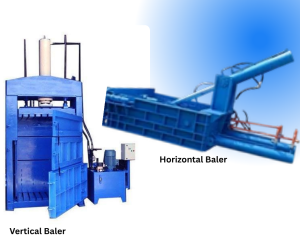
Vertical balers (closed-end / vertical hydraulic) — compact footprint, lower cost, suitable for low to medium throughput (retail, small sorting centres). Often manually fed and tied, good for cardboard and light plastics.
Horizontal single-ram balers — mid to high throughput; one platen compresses material into bales; good for paper, plastics, fibres. Often used where continuous feed (conveyor) is available.
Horizontal two-ram (dual-ram) balers — higher throughput, higher density bales, better for tough or bulky materials (tyres, some plastics, mixed recyclables). Two-ram designs can produce larger, denser bales more quickly.
Specialised balers (round, silage, agricultural) — for farm uses or specific commodities; not usually interchangeable with recycling/industrial balers.
Match material + throughput + available floor space to these types before comparing prices or suppliers.
-
Key technical specifications to compare
When evaluating models, check these concrete specs — they determine performance and long-term costs:
Tonnage / compression force (tonnes) — higher tonnage = denser bales. For plastics and metals, higher tonnage may be required.
Bale size and bale weight — expressed as dimensions (e.g., 600×400×800 mm) and expected bale weight per material. Ensure bale size suits your transport and storage logistics.
Click here to read more on bale size & weight: https://bsmrengineering.com.ng/why-bale-size-and-weight-matter-in-recycling-and-waste-management-bale-dimensioning/
Cycle time / bales per hour — tells you real throughput. Don’t assume advertised cycle = real throughput; factor in loading time, tying, and downtime.
Power requirements — motor kW, voltage, phases. Confirm your site’s electrical supply (single/three phase) and whether a generator will be needed.
Automation & feeding — manual top load vs. Conveyor fed. Automation increases cost but reduces labour and speeds throughput.
Hydraulic system details — pump capacity, reservoir size, hoses and pressure ratings; these affect reliability and maintenance.
Controls & safety features — emergency stops, interlocks, safety guards, remote diagnostics (if available). Industrial standards and safe operation should be non-negotiable.
-
Site, logistics and installation — plan up front
Many buyers underestimate site preparation. Avoid surprises: In the past, many customers have had to bring down their sheds inorder to bring in the machine by a self-loader.
Floor & foundation: horizontal/two-ram balers are heavy and may need concrete foundations or level, load-bearing floors. Vertical balers still need a stable floor and clear space for loading and tying.
Ceiling height & yard access: ensure bale ejection and stack heights fit ceilings and gateways; check turning radius for trucks.
Power & utilities: confirm three-phase power availability, cable runs, and whether voltage stabilisers or a generator are needed.
Material handling: plan conveyors, tippers, forklifts and bale storage racks. Automated feed systems require upstream conveyors and separation machinery.
Transport: inquire about the means & cost of transportation from the point of purchase to your destination — confirm these before committing.
-
Supplier, service & spare parts — the non-negotiables
A low purchase price is worthless if the machine sits idle weeks waiting for parts or service.
Local representation & service: if imported prefer suppliers or distributors with local presence or Nigerian partners who can provide prompt parts, technicians, and warranty support. Verify service response times and after sales services for locally made machines.
Spare parts availability: how readily available are seals, hoses, hydraulic pumps, electrical components and wear plates? Ask about lead times and local stock.
Warranty & scope: get written warranty terms — what is covered (hydraulic system, electronics, labour), and for how long. Know where warranty repairs are performed (local or overseas).
Training for operators & maintainers: Supplier should provide training for safe operation, basic troubleshooting, and preventive maintenance. Lack of training is a common cause of early machine failure.
-
New vs used — pros, cons and what to inspect
Used balers can be a smart option if you inspect them properly.
Advantages of used: lower capital cost; some used balers have long useful lives and can be reliable purchases.
Risks of used: unknown maintenance history, worn hydraulics, thinned structural steel, or obsolete spare parts. Always request service records, and if possible, test on your material.
Inspection checklist for used machines: visual structural inspection (frame, welds), hydraulic oil cleanliness and level, cylinder seals, hoses, electrical cabinet (corrosion), cycle test under load, and history of parts replaced.
-
Safety, compliance and operator training
Baling machines can cause serious injuries if not operated safely. Make sure:
The machine meets relevant safety standards and has emergency stops, interlocks and guards (for electricaly controlled balers).
Your staff receive formal training, documented SOPs and PPE (gloves, boots, eye protection).
-
Total cost of ownership (TCO) — look past the sticker price
Calculate a realistic 2-year TCO that includes:
Purchase price
Transportation
Installation, foundation work, and site preparation.
Annual maintenance (hydraulic oil, seals, replacement wires/strapping), expected spare parts, and labour for maintenance.
Energy costs (kW × running hours).
Downtime costs (lost throughput while waiting for parts/service).
Resale value or depreciation and expected useful life.
-
Practical procurement checklist — questions to ask every supplier
Use this when speaking to vendors or evaluating quotes:
- What material(s) is this exact model intended for? Provide datasheets.
- What is the compression force (tonnage) and expected bale density for our material?
- What is the real cycle time and bales/hour when used with our material?
- Exact bale dimensions and weight ranges for our material.
- Full electrical requirements (kW, voltage, phase) and recommended generator specs if needed.
- Warranty terms, exclusions, and where warranty repairs are carried out.
- Availability & cost of commonly replaced parts; typical lead times in Nigeria.
- Service & training included — what is covered, and is there a service contract option?
- References from other Nigerian customers — can they share contactable references or site visits?
- Total landed cost (machine + transport + installation).
-
Financing, warranties and post-sale arrangements
Negotiate spare parts packages or first-year service included in the sale.
Get warranties and spare parts commitments in writing.
-
Red flags to avoid
No local service or spare-parts presence for complex machines.
Vague specs (no real cycle time or no bale density figures).
Sellers who won’t allow an on-site test or can’t provide references from Nigerian users.
Extremely low price with no explanation — often hides poor build quality, missing features or lack of after-sales support.
-
Final decision checklist — before you sign
Confirm material match, capacity, power and footprint.
Confirm total landed cost (machine + all extras).
Verify warranty, spare parts availability and local service contacts.
Confirm operator training and maintenance plan.
Compare at least 3 quotes (local + importer + used market) and run a two-year TCO analysis.
Closing: buy for operations, not just price
A baler that fits your material, throughput and service network will save far more money than the small amount you might save by choosing the cheapest machine. Prioritize material suitability, local support, and realistic TCO.
Reach out to us today at BSMR Engineering Services, Call/WhatsApp – 09036044847. Let’s turn your throughput needs/target into an equipment spec (recommended tonnage, bale size, and automation level),
Conclusion
Buying a baling machine in Nigeria is not just about finding a unit that fits your budget — it’s about making a strategic investment that aligns with your material type, production capacity, and long-term operational goals. The right baler will improve your efficiency, reduce handling costs, and help you meet the quality standards demanded by your buyers or waste disposal requirements.
By taking the time to assess your needs, understand the different machine types, verify technical specifications, prepare your site, and confirm local service and spare parts availability, you greatly reduce the risk of costly downtime or buyer’s regret.
In the Nigerian market — where import delays, inconsistent power supply, and varying material prices are realities — careful planning and due diligence are your best allies. Think beyond the purchase price and focus on total cost of ownership, long-term reliability, and resale value.
When you make an informed choice, your baling machine becomes more than just a piece of equipment — it becomes a profit-generating asset that supports your business for years to come.